Filter by Category
Face-to-Face Classes

PRISM-certified® - Bundle Discounted Price
with Angela Summers

Purchase all three classes in one bundle and save $750.
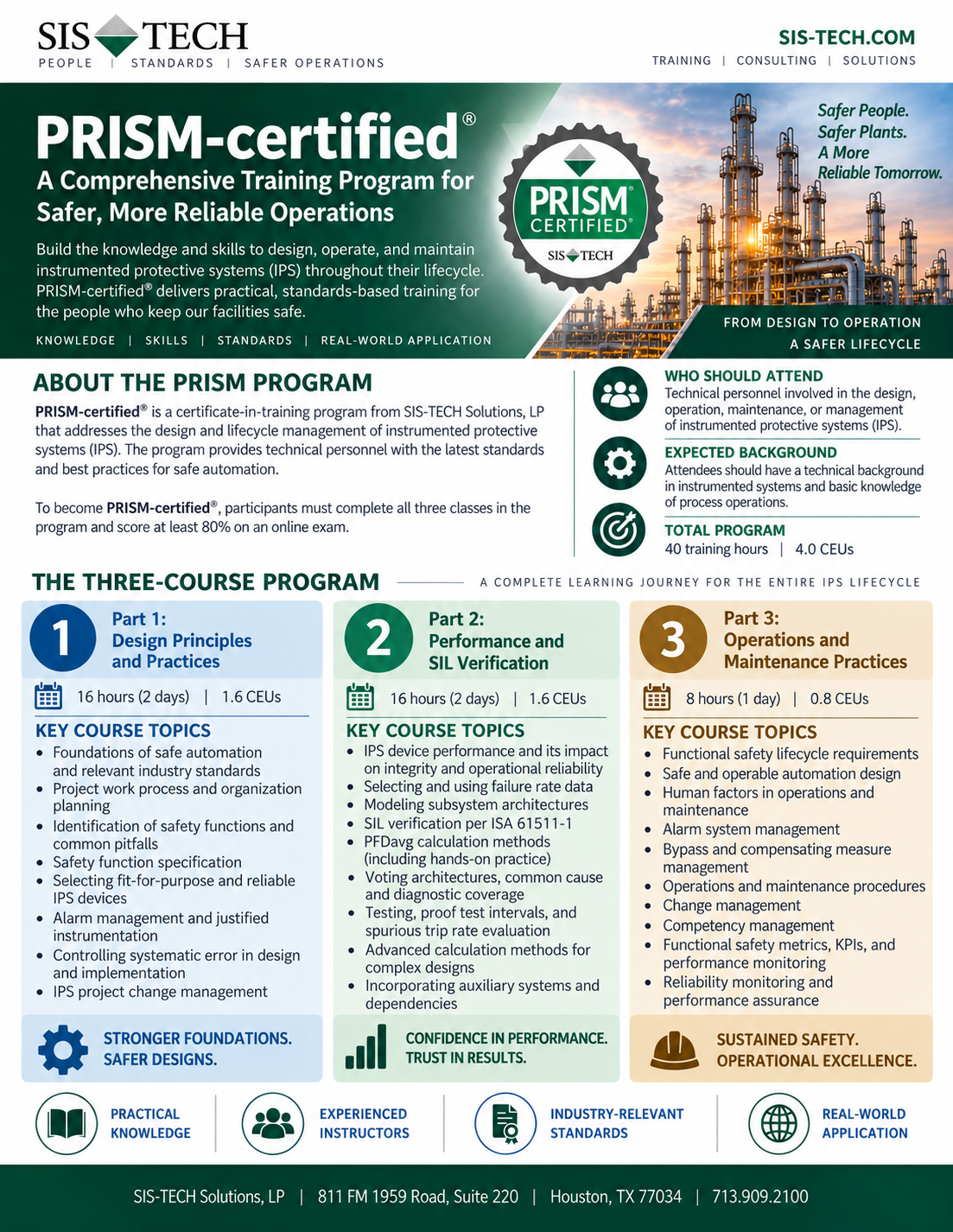
PRISM-certified® is a certificate-in-training program from SIS-TECH Solutions, LP that addresses the design and lifecycle management of instrumented protective systems (IPS). The program provides technical personnel with the latest standards and best practices for safe automation.
To become PRISM-certified®, participants must complete all three classes in the program and score at least 80% on an online exam.
Part 1: IPS Design Principles and Practices
Part 2: IPS Performance and SIL Verification
Part 3: IPS Operations and Maintenance Practices
Pre-requisites
This course and the PRISM-certified® program have no specific education, experience, or nomination requirements. Participants earn PRISM Certification by successfully completing the required classes and testing. Attendees are expected to have a technical background in instrumented systems and basic knowledge of process operations.

IPS Design Principles and Practices
with Angela Summers
PRISM-certified® - Part 1: IPS Design Principles and Practices
Overview
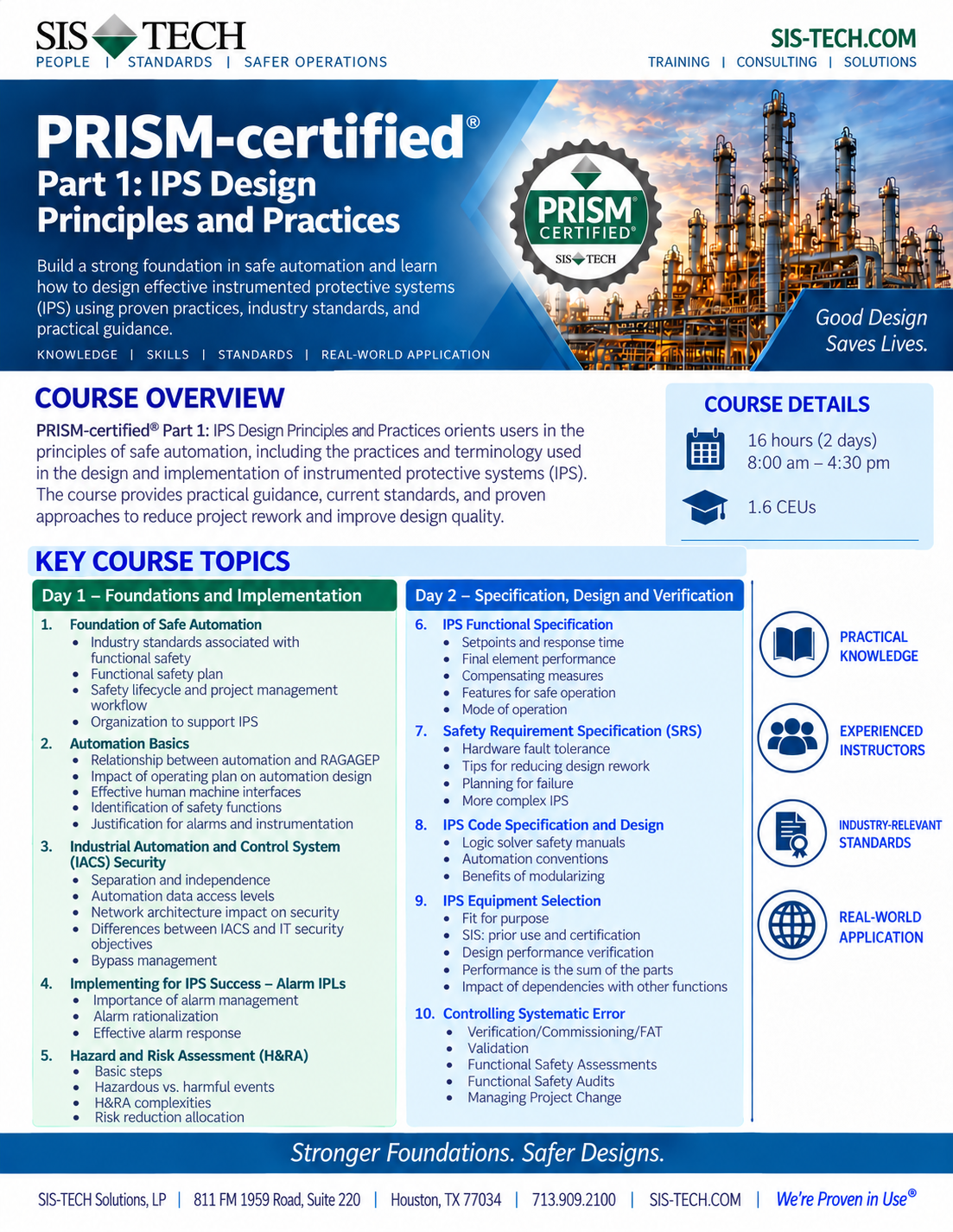
PRISM-certified® is a certificate-in-training program addressing the design and lifecycle management of instrumented protective systems. The target audience includes technical personnel who need to understand the latest standards and practices for safe automation. To become PRISM-certified®, students must complete all three classes in the program and score at least 80% on an online exam.
This course orients users in the principles of safe automation, including the practices and terminology used in the design and implementation of instrumented protective systems (IPS). Experienced personnel can also benefit from awareness of recent developments in IPS standards, tips for reducing IPS-related project rework, and techniques for communicating safe automation concepts to newer employees.
Pre-requisites
This course and the PRISM-certified® program have no specific education, experience, or nomination requirements. Participants earn PRISM Certification by successfully completing the required classes and testing. Attendees are expected to have a technical background in instrumented systems and basic knowledge of process operations.
Objectives
The course participants will gain an understanding of the following:
- Relationship between inherently safer design and functional safety
- How IPS are included in the standard project work process and project organization planning
- Pitfalls in IPS identification that can lead to IPS design problems
- Fundamentals of safety function specification
- Selecting IPS devices that are fit for purpose and reliable
- Essentials of alarm management, including instrument and alarm justification
- Activities designed to control systematic error during IPS specification, design, and implementation
- IPS project change management

SIL Verification and IPS Performance
with Angela Summers
PRISM-certified® - Part 2: IPS Performance and SIL Verification
Overview
PRISM-certified® is a certificate-in-training program addressing the design and lifecycle management of instrumented protective systems. The target audience includes technical personnel who need to understand the latest standards and practices for safe automation. To become PRISM-certified®, students must complete all three classes in the program and score at least 80% on an online exam.
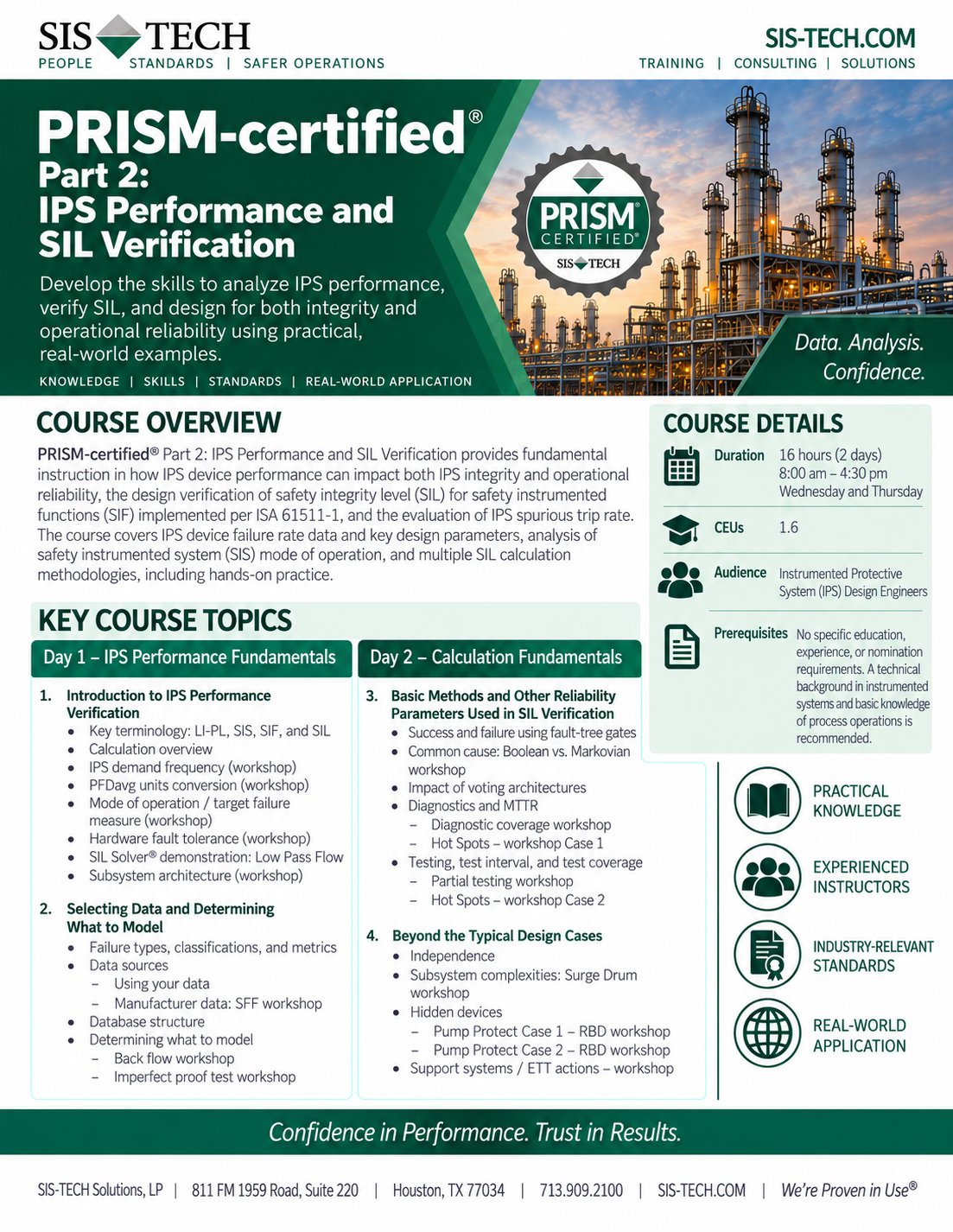
This course provides fundamental instruction in the ways IPS device performance can impact both IPS integrity and operational reliability, the design verification of safety integrity level (SIL) for safety instrumented functions (SIF) implemented per ISA 61511-1, and the evaluation of IPS spurious trip rate. Course covers IPS device failure rate data and key design parameters, analysis of safety instrumented system (SIS) mode of operation, and multiple SIL calculation methodologies, including hands-on practice.
Student Materials
Attendees should bring a laptop to participate in supplemental exercises using software
Pre-requisites
This course and the PRISM-certified® program have no specific education, experience, or nomination requirements. Participants earn PRISM Certification by successfully completing the required classes and testing. Attendees are expected to have a technical background in instrumented systems and basic knowledge of process operations.
Objectives
The course participants will gain an understanding of the following:
- Impact of SIS mode of operation on methodology used for SIL calculation
- Approaches for selection of data to be used in SIL calculations and situations where modification of the source values may be needed
- Identification of the hardware subsystems to include in the SIL calculation
- Two most common calculation methods for performing PFDavg calculations
- Basic diagramming methods to use when understanding subsystem architectures
- Impact of voting architecture and specified SIF response to detected failure on the calculated PFDavg
- Potential use of diagnostics and partial testing to satisfy proof test interval targets from the SIS specification.
- How to recognize SIS designs that will require a more advanced calculation methods
- Recognizing when it is necessary to incorporate automation utility or other auxiliary systems in the SIL calculation

IPS and SIS Operations and Maintenance Practices
with Angela Summers
PRISM-certified® - Part 3: IPS Operations and Maintenance Practices
Overview
PRISM-certified® is a certificate-in-training program addressing the design and lifecycle management of instrumented protective systems. The target audience includes technical personnel who need to understand the latest standards and practices for safe automation. To become PRISM-certified®, students must complete all three classes in the program and score at least 80% on an online exam.
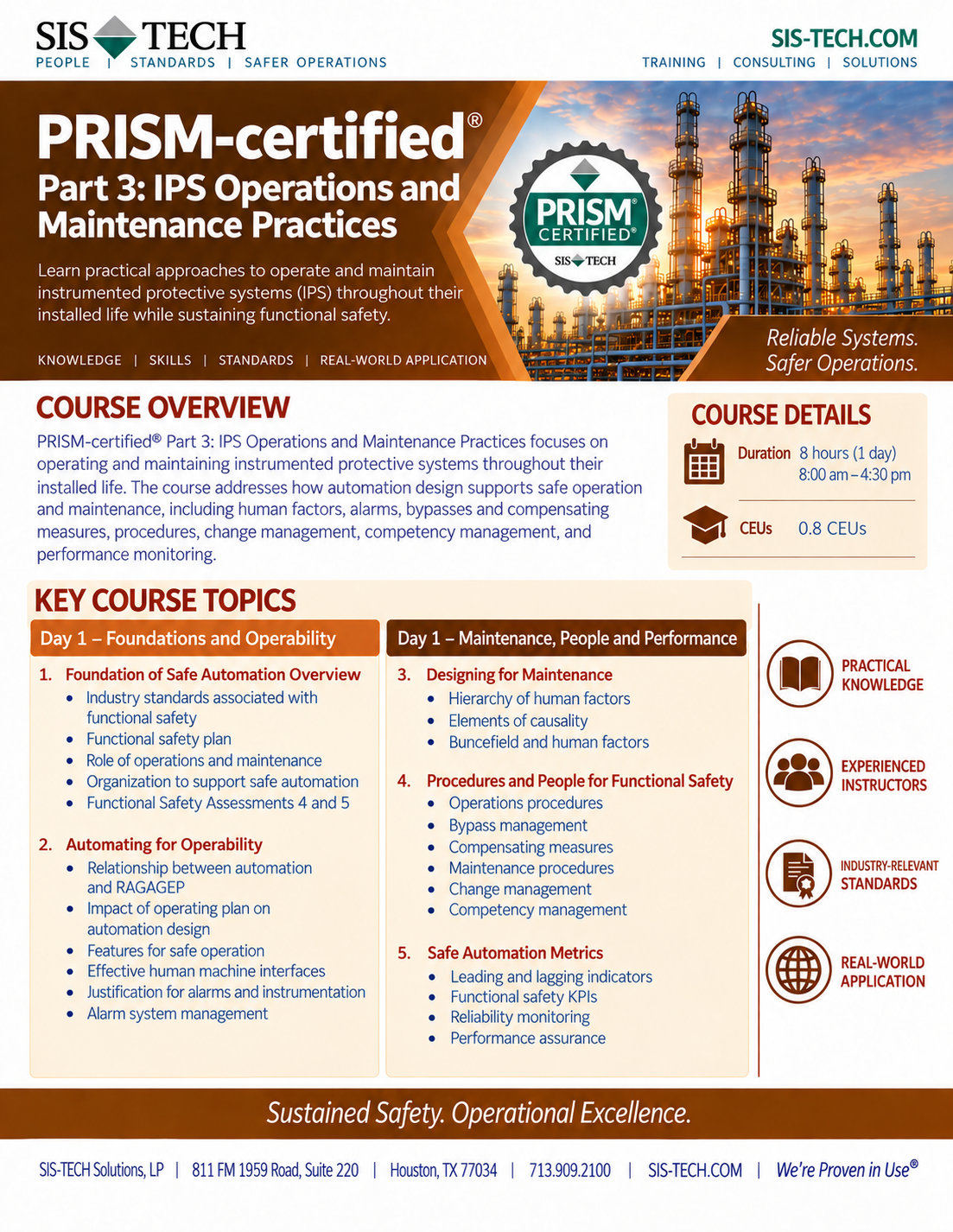
This course focuses on operating and maintaining instrumented protective systems throughout their installed life. The course addresses how automation design supports safe operation and maintenance, including human factors, alarms, bypasses and compensating measures, procedures, change management, competency management, and performance monitoring. Participants learn practical approaches for maintaining functional safety and assessing system performance over time.
Pre-requisites
This course and the PRISM-certified® program have no specific education, experience, or nomination requirements. Participants earn PRISM Certification by successfully completing the required classes and testing. Attendees are expected to have a technical background in instrumented systems and basic knowledge of process operations.
Objectives
The course participants will gain an understanding of the following:
- Functional safety lifecycle requirements
- Safe and operable automation design
- Human factors in operations and maintenance
- Bypass and compensating measure management
- Maintenance, change, and competency management
- Functional safety metrics and performance monitoring

TÜV Rheinland Functional Safety Engineer Certification
with Eloise Roche
This 4-day TÜV Functional Safety Engineer preparation course delivers a comprehensive, hands-on refresher on the ISA/IEC 61511 standard, equipping participants with the breadth of knowledge required for exam success.
The course goes beyond narrow expertise to provide a holistic understanding of the safety lifecycle—from hazard identification and safety requirements specification to design, implementation, operation, and maintenance of Safety Instrumented Systems (SIS). Participants will review essential terminology, functional safety planning, and updated risk assessment approaches such as LOPA and event tree methods.
Core topics include pragmatic development of the SRS, device approval pathways, design constraints for achieving SIL targets, and mandatory assurance activities across the lifecycle. The course also emphasizes real-world practices for sustaining SIS performance in operations, including managing bypasses, compensating measures, and change management. Supplemented by engaging exercises, attendees will practice critical skills such as allocating safety functions, applying SIL verification techniques, calculating PFDavg with Boolean and Markov methods, and managing lifecycle integrity.
By combining rigorous technical content with interactive application, this course provides an engaging and practical path to mastering functional safety and preparing with confidence for the TÜV certification exam.
The detailed course outline can be found here. 4_5 day TUV
If you are a first-time student or a 10-year renewal, SIS-TECH maintains a flat course fee of $3,400 for all TÜV students. Students renewing their 10-year TÜV certificate receive a $250 loyalty discount, applied internally by SIS-TECH. The discount covers the additional renewal fee charged by TÜV, allowing returning students to maintain the same total course cost.
If you have any questions, contact Angie Fierros, afierros@sis-tech.com or 713-909-2137.